

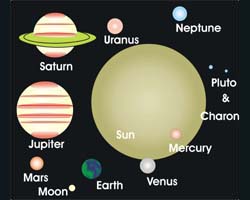
The solar system consists of the Sun; the eight official planets, at least three "dwarf planets", more than 130 satellites of the planets, a large number of small bodies (the comets and asteroids), and the interplanetary medium.
The inner solar system contains the Sun,Mercury, Venus, Earth and Mars: The main asteroid belt (not shown) lies between the orbits of Mars and Jupiter. The planets of the outer solar system are Jupiter, Saturn, Uranus, and Neptune (Pluto is now classified as a dwarf planet):
The first thing to notice is that the solar system is mostly empty space. The planets are very small compared to the space between them.
The orbits of the planets are ellipses with the Sun at one focus, though all except Mercury are very nearly circular. The orbits of the planets are all more or less in the same plane (called the ecliptic and defined by the plane of the Earth's orbit).
The ecliptic
is inclined only 7 degrees from the plane of the Sun's equator. They all orbit in the same direction (counter-clockwise looking down from above the Sun's North Pole); all but Venus, Uranus and Pluto also rotate in that same sense.
The Sun is by far the largest object in the solar system. It contains more than 99.8% of the total mass of the Solar System (Jupiter contains most of the rest).
It is often said that the Sun is an "ordinary" star. That's true in the sense that there are many others similar to it. But there are many smaller stars than larger ones; the Sun is in the top 10% by mass. The median size of stars in our galaxy is probably less than half the mass of the Sun.
The Sun is personified in many mythologies: the Greeks called it Helios and the Romans called it Sol .The Sun is, at present, about 70% hydrogen and 28% helium by mass everything else ("metals ") amounts to less than 2%. This changes slowly over time as the Sun converts hydrogen to helium in its core.
The outer layers of the Sun exhibit differential rotation: at the equator the surface rotates once every 25.4 days; near the poles it's as much as 36 days. This odd behavior is due to the fact that the Sun is not a solid body like the Earth. Similar effects are seen in the gas planets . The differential rotation extends considerably down into the interior of the Sun but the core of the Sun rotates as a solid body.
Conditions at the Sun's
core core (approximately the inner 25% of its radius) are extreme. The temperature is 15.6 million Kelvin and the pressure is 250 billion atmospheres . At the center of the core the Sun's density is more than 150 times that of water.
The Sun's energy output (3.86e33 ergs/second or 386 billion billion megawatts) is produced by nuclear fusion reactions. Each second about 700,000,000 tons of hydrogen are converted to about 695,000,000 tons of helium and 5,000,000 tons (=3.86e33 ergs) of energy in the form of gamma rays. As it travels out toward the surface, the energy is continuously absorbed and re-emitted at lower and lower temperatures so that by the time it reaches the surface, it is primarily visible light. For the last 20% of the way to the surface the energy is carried more byconvection than by radiation.
The surface of the Sun, called the photosphere , is at a temperature of about 5800 K.Sunspots are "cool" regions, only 3800 K (they look dark only by comparison with the surrounding regions). Sunspots can be very large, as much as 50,000 km in diameter. Sunspots are caused by complicated and not very well understood interactions with the Sun's magnetic field.
A small region known as the
chromosphere lies above the photosphere.
It just happens that the Moon and the Sun appear the same size in the sky as viewed from the Earth. And since the Moon orbits the Earth in approximately the same plane as thThe highly rarefied region above the chromosphere, called the corona, extends millions of kilometers into space but is visible only during a total solar eclipse (left). Temperatures in the corona are over 1,000,000 K.
Earth's orbit around the Sun sometimes the Moon comes directly between the Earth and the Sun. This is called a solar eclipse; if the alignment is slighly imperfect then the Moon covers only part of the Sun's disk and the event is called a partial eclipse. When it lines up perfectly the entire solar disk is blocked and it is called a total eclipse of the Sun. Partial eclipses are visible over a wide area of the Earth but the region from which a total eclipse is visible, called the path of totality, is very narrow, just a few kilometers (though it is usually thousands of kilometers long). Eclipses of the Sun happen once or twice a year. To stand in the shadow of the Moon is an awesome experience. For a few precious minutes it gets dark in the middle of the day. The stars come out. The animals and birds think it's time to sleep. And you can see the solar corona. It is well worth a major journey.
The Sun's magnetic field is very strong (by terrestrial standards) and very complicated. Its magnetosphere (also known as the heliosphere ) extends well beyond Pluto.
In addition to heat and light, the Sun also emits a low density stream of charged particles (mostly electrons and protons) known as the solar wind which propagates throughout the solar system at about 450 km/sec. The solar wind and the much higher energy particles ejected by solar flares can have dramatic effects on the Earth ranging from power line surges to radio interference to the beautiful
aurora borealis.
Recent data from the spacecraft Ulysses show that during the minimum of the solar cycle the solar wind emanating from the Polar Regions flows at nearly double the rate, 750 kilometers per second that it does at lower latitudes. The composition of the solar wind also appears to differ in the Polar Regions. During the solar maximum, however, the solar wind moves at an intermediate speed . The solar wind has large effects on the tails of comets and even has measurable effects on the trajectories of spacecraft.
The Sun's output is not entirely constant. Nor is the amount of sunspot activity. There was a period of very low sunspot activity in the latter half of the 17th century called the Maunder Minimum. It coincides with an abnormally cold period in northern Europe sometimes known as the Little Ice Age. Since the formation of the solar system the Sun's output has increased by about 40%.
The Sun is about 4.5 billion years old. Since its birth it has used up about half of the hydrogen in its core. It will continue to radiate "peacefully" for another 5 billion years or so (although its luminosity will approximately double in that time). But eventually it will run out of hydrogen fuel. It will then be forced into radical changes which, though commonplace by stellar standards, will result in the total destruction of the Earth (and probably the creation of a planetary nebula .
Mercury is the closest planet to the Sun and the eighth largest. Mercury is slightly smaller in diameter than the moons Ganymede and
Titan but more than twice as massive.
orbit : 57,910,000 km (0.38 AU) from Sun
diameter : 4,880 km
mass : 3.30e23 kg
In Roman mythology Mercury is the god of commerce, travel and thievery, the Roman counterpart of the Greek god
Hermes , the messenger of the Gods. The planet probably received this name because it moves so quickly across the sky
Mercury has been known since at least the time of the Sumerians (3rd millennium BC). It was given two names by the Greeks: Apollo for its apparition as a morning star and Hermes as an evening star. Greek astronomers knew, however, that the two names referred to the same body. Heraclitus even believed that Mercury and Venus orbit the Sun, not the Earth.
Mercury has been visited by only one spacecraft, Mariner 10. It flew by three times in 1974 and 1975. Only 45% of the surface was mapped (and, unfortunately, it is too close to the Sun to be safely imaged by HST ). A new discovery-class mission to Mercury, MESSENGER was launched by NASA in 2004 and will orbit Mercury starting in 2011 after several flybys.
Mercury's orbit is highly eccentric ; at perihelion it is only 46 million km from the Sun but at aphelion it is 70 million. The position of the perihelion precesses around the Sun at a very slow rate. 19th century astronomers made very careful observations of Mercury's orbital parameters but could not adequately explain them using Newtonian mechanics. The tiny differences between the observed and predicted values were a minor but nagging problem for many decades. It was thought that another planet (sometimes called Vulcan) slightly closer to the Sun than Mercury might account for the discrepancy. But despite much effort, no such planet was found. The real answer turned out to be much more dramatic: Einstein's General Theory of Relativity! Its correct prediction of the motions of Mercury was an important factor in the early acceptance of the theory.
Until 1962 it was thought that Mercury's "day" was the same length as its "year" so as to keep that same face to the Sun much as the Moon does to the Earth. But this was shown to be false in 1965 by doppler radar observations. It is now known that Mercury rotates three times in two of its years. Mercury is the only body in the solar system known to have an orbital/rotational resonance with a ratio other than 1:1 (though many have no resonances at all).
This fact and the high eccentricity of Mercury's orbit would produce very strange effects for an observer on Mercury's surface. At some longitudes the observer would see the Sun rise and then gradually increase in apparent size as it slowly moved toward the zenith. At that point the Sun would stop, briefly reverse course, and stop again before resuming its path toward the horizon and decreasing in apparent size. All the while the stars would be moving three times faster across the sky. Observers at other points on Mercury's surface would see different but equally bizarre motions.
Temperature variations on Mercury are the most extreme in the solar system ranging from 90 K to 700 K. The temperature on Venus is slightly hotter but very stable.
Mercury is in many ways similar to the Moon : its surface is heavily cratered and very old; it has no plate tectonics . On the other hand, Mercury is much denser than the Moon (5.43 gm/cm3 vs 3.34). Mercury is the second densest major body in the solar system, after
Earth . Actually Earth's density is due in part to gravitational compression; if not for this, Mercury would be denser than Earth. This indicates that Mercury's dense iron core is relatively larger than Earth, probably comprises the majority of the planet. Mercury therefore has only a relatively thin silicate mantle and crust.
Mercury's interior is dominated by a large iron core whose radius is 1800 to 1900 km. The silicate outer shell (analogous to Earth's mantle and crust) is only 500 to 600 km thick. At least some of the core is probably molten.Mercury actually has a very thin atmosphere consisting of atoms blasted off its surface by the solar wind . Because Mercury is so hot, these atoms quickly escape into space. Thus in contrast to the Earth and Venus whose atmospheres are stable, Mercury's atmosphere is constantly being replenished.
The surface of Mercury exhibits enormous escarpments, some up to hundreds of kilometers in length and as much as three kilometers high. Some cut thru the rings of craters and other features in such a way as to indicate that they were formed by compression. It is estimated that the surface area of Mercury shrank by about 0.1% (or a decrease of about 1 km in the planet's radius).
One of the largest features on Mercury's surface is the Caloris Basin (right); it is about 1300 km in diameter. It is thought to be similar to the large basins (maria) on the Moon. Like the lunar basins, it was probably caused by a very large impact early in the history of the solar system. That impact was probably also responsible for the odd terrain on the exact opposite side of the planet
In addition to the heavily cratered terrain, Mercury also has regions of relatively smooth plains. Some may be the result of ancient volcanic activity but some may be the result of the deposition of ejecta from cratering impacts.A reanalysis reanalysis of the Mariner data provides some preliminary evidence of recent volcanism on Mercury. But more data will be required for confirmation.
Amazingly, radar observations of Mercury's North Pole (a region not mapped by Mariner 10) show evidence of water ice in the protected shadows of some craters.Mercury has a small magnetic field whose strength is about 1% of Earth's.
Mercury has no known satellites.Mercury is often visible with binoculars or even the unaided eye, but it is always very near the Sun and difficult to see in the twilight sky.
Mercury is often Venus is the second planet from the Sun with and the sixth largest. Venus' orbit is the most nearly circular of that of any planet, with an eccentricity of less than 1%.
orbit with : 108,200,000 km (0.72 AU) from Sun diametert with diameter: 12,103.6 km mass with : 4.869e24 kg Venus with (Greek:
Aphrodite with ; Babylonian: Ishtar) is the goddess of love and beauty. The planet is so named probably because it is the
brightest with of the planets known to the ancients.
Venus has been known since prehistoric times. It is the brightest object in the sky except for the Sun and the Moon. Like Mercury , it was popularly thought to be two separate bodies: Eosphorus as the morning star and Hesperus as the evening star, but the Greek astronomers knew better. (Venus's apparition as the morning star is also sometimes called Lucifer.)
Since Venus is an inferior planet, it shows phases when viewed with a telescope from the perspective of Earth. Galileo's observation of this phenomenon was important evidence in favor of Copernicus's heliocentric theory of the solar system. The first spacecraft to visit Venus was Mariner 2 in 1962. It was subsequently visited by many others (more than 20 in all so far), including Pioneer Venus and the Soviet Venera 7 the first spacecraft to land on another planet, and Venera 9 which returned the first photographs of the surface. The first orbiter, the US spacecraft Magellan produced detailed maps of Venus' surface using radar. ESA's Venus Express is now in orbit with a large variety of instruments.
Venus' rotation is somewhat unusual in that it is both very slow (243 Earth days per Venus day, slightly longer than Venus' year) and
retrograde . In addition, the periods of Venus' rotation and of its orbit are synchronized such that it always presents the same face toward Earth when the two planets are at their closest approach. Whether this is a resonance effect or merely a coincidence is not known
Venus is sometimes regarded as Earth's sister planet. In some ways they are very similar
• Venus is only slightly smaller than Earth (95% of Earth's diameter, 80% of Earth's mass).
• Both have few craters indicating relatively young surfaces.
• Their densities and chemical compositions are similar.
Because of these similarities, it was thought that below its dense clouds Venus might be very earthlike and might even have life. But, unfortunately, more detailed study of Venus reveals that in many important ways it is radically different from Earth. It may be the least hospitable place for life in the solar system.
The pressure of Venus' atmosphere at the surface is 90 atmospheres (about the same as the pressure at a depth of 1 km in Earth's oceans). It is composed mostly of carbon dioxide. There are several layers of clouds many kilometers thick composed of sulfuric acid. These clouds completely obscure our view of the surface. This dense atmosphere produces a run-away greenhouse effect that raises Venus' surface temperature by about 400 degrees to over 740 K (hot enough to melt lead). Venus' surface is actually hotter than Mercury's despite being nearly twice as far from the Sun. There are strong (350 kph) winds at the cloud tops but winds at the surface are very slow, no more than a few kilometers per hour.
Venus probably once had large amounts of water like Earth but it all boiled away. Venus is now quite dry. Earth would have suffered the same fate had it been just a little closer to the Sun.Most of Venus' surface consists of gently rolling plains with little relief. There are also several broad depressions: Atalanta Planitia, Guinevere Planitia, Lavinia Planitia . There two large highland areas:
Ishtar Terra Ishtar Terra in the northern hemisphere (about the size of Australia) and Aphrodite Terra along the equator (about the size of South America). The interior of Ishtar consists mainly of a high plateau,Lakshmi Planum , which is surrounded by the highest mountains on Venus including the enormous Maxwell .
Data from Magellan's imaging radar shows that much of the surface of Venus is covered by lava flows. There are several large shield volcanoes (similar to Hawaii or Olympus Mons ) such as Sif Mons . Recently announced findings indicate that Venus is still volcanically active, but only in a few hot spots; for the most part it has been geologically rather quiet for the past few hundred million years.
There are no small craters on Venus. It seems that small meteoroids burn up in Venus' dense atmosphere before reaching the surface. Craters on Venus seem to come in bunches indicating that large meteoroids that do reach the surface usually break up in the atmosphere.
The oldest terrains on Venus seem to be about 800 million years old. Extensive volcanism at that time wiped out the earlier surface including any large craters from early in Venus' history.Magellan's images show a wide variety of interesting and unique features including pancake volcanoes which seem to be eruptions of very thick lava and coronae which seem to be collapsed domes over large magma chambers.
The interior of Venus is probably very similar to that of Earth: an iron core about 3000 km in radius, a molten rocky mantle comprising the majority of the planet. Recent results from the Magellan gravity data indicate that Venus' crust is stronger and thicker than had previously been assumed. Like Earth,convection in the mantle produces stress on the surface which is relieved in many relatively small regions instead of being concentrated at plate boundaries as is the case on Earth.Venus has no magnetic field, perhaps because of its slow rotation.Venus has no satellites, and thereby hangs a tale .
Venus is usually visible . with the unaided eye. Sometimes (inaccurately) referred to as the "morning star" or the "evening star", it is by far the brightest "star" in the sky.
On June 8 2004, Venus passed directly between the Earth and the Sun, appearing as a large black dot travelling across the Sun's disk. This event is known as a "transit of Venus" and is very rare: the last one was in 1882; the next one is in 2012 but after than you'll have to wait until 2117. While no longer of great scientific importance as it was in the past, this event was the impetus for a major
journey for many amateur astronomers Earth is the third planet from the Sun and the fifth largest:
orbit : 149,600,000 km (1.00 AU) from Sun
diameter : 12,756.3 km
mass : 5.972e24 kg
Earth is the only planet whose English name does not derive from Greek/Roman mythology. The name derives from Old English and Germanic. There are, of course, hundreds of other names for the planet in other languages. . In Roman Mythology, the goddess of the Earth was
Tellus - the fertile soil (Greek: Gaia , terra mater - Mother Earth).It was not until the time of Copernicus (the sixteenth century) that it was understood that the Earth is just another planet.
The Earth is divided into several layers which have distinct chemical and seismic properties (depths in km):
0- 40 Crust
40- 400 Upper mantle
400- 650 Transition region
650-2700 Lower mantle
2700-2890 D'' layer
2890-5150 Outer core
5150-6378 Inner core
The crust varies considerably in thickness; it is thinner under the oceans, thicker under the continents. The inner core and crust are solid; the outer core and mantle layers are plastic or semi-fluid. The various layers are separated by discontinuities which are evident in seismic data; the best known of these is the Mohorovicic discontinuity between the crust and upper mantle.
Most of the mass of the Earth is in the mantle, most of the rest in the core; the part we inhabit is a tiny fraction of the whole (values below x10^24 kilograms):
atmosphere = 0.0000051
oceans = 0.0014
crust = 0.026
mantle = 4.043
outer core = 1.835
inner core = 0.09675
The core is probably composed mostly of iron (or nickel/iron) though it is possible that some lighter elements may be present, too. Temperatures at the center of the core may be as high as 7500 K, hotter than the surface of the Sun . The lower mantle is probably mostly silicon, magnesium and oxygen with some iron, calcium and aluminum. The upper mantle is mostly olivene and pyroxene iron/magnesium silicates ), calcium and aluminum. We know most of this only from seismic techniques; samples from the upper mantle arrive at the surface as lava from volcanoes but the majority of the Earth is inaccessible. The crust is primarily quartz (silicon dioxide) and other silicates like feldspar. Taken as a whole, the Earth's chemical composition (by mass) is:
34.6% Iron
29.5% Oxygen
15.2% Silicon
12.7% Magnesium
2.4% Nickel
1.9% Sulfur
0.05% Titanium
The Earth is the
densest major body in the solar system.
The other terrestrial planets probably have similar structures and compositions with some differences: the Moon has at most a small core; Mercury has an extra large core (relative to its diameter); the mantles of Mars and the Moon are much thicker; the Moon and Mercury may not have chemically distinct crusts; Earth may be the only one with distinct inner and outer cores.Unlike the other terrestrial planets, Earth's crust is divided into several separate solid plates which float around independently on top of the hot mantle below. The theory that describes this is known as plate tectonics . It is characterized by two major processes: spreading and subduction. Spreading occurs when two plates move away from each other and new crust is created by upwelling magma from below. Subduction occurs when two plates collide and the edge of one dive beneath the other and ends up being destroyed in the mantle. There is also transverse motion at some plate boundaries (i.e. the San Andreas Fault in California) and collisions between continental plates (i.e. India/Eurasia). There are (at present) eight major plates:
1- North American Plate - North America, western North Atlantic and Greenland
2- South American Plate - South America and western South Atlantic
3- Antarctic Plate - Antarctica and the "Southern Ocean"
4- Eurasian Plate - eastern North Atlantic, Europe and Asia except for India
5- African Plate - Africa, eastern South Atlantic and western Indian Ocean
6- Indian-Australian Plate - India, Australia, New Zealand and most of Indian Ocean
7- Nazca Plate - eastern Pacific Ocean adjacent to South America
8- Pacific Plate - most of the Pacific Ocean (and the southern coast of California!)
There are also twenty or more small plates such as the Arabian, Cocos, and Philippine Plates. Earthquakes are much more common at the plate boundaries. Plotting their locations makes it easy to see the plate boundaries.
The Earth's surface is very
young . In the relatively short (by astronomical standards) period of 500,000,000 years or so erosion and tectonic processes destroy and recreate most of the Earth's surface and thereby eliminate almost all traces of earlier geologic surface history (such as impact craters). Thus the very early history of the Earth has mostly been erased. The Earth is 4.5 to 4.6 billion years old, but the oldest known rocks are about 4 billion years old and rocks older than 3 billion years are rare. The oldest fossils of living organisms are less than 3.9 billion years old. There is no record of the critical period when life was first getting started.
71 Percent of the Earth's surface is covered with water. Earth is the only planet on which water can exist in liquid form on the surface (though there may be liquid ethane or methane on Titan's surface and liquid water beneath the surface of Europa). Liquid water is, of course, essential for life as we know it. The heat capacity of the oceans is also very important in keeping the Earth's temperature relatively stable. Liquid water is also responsible for most of the erosion and weathering of the Earth's continents, a process unique in the solar system today (though it may have occurred on Mars in the past).
The Earth's atmosphere is 77% nitrogen, 21% oxygen , with traces of argon, carbon dioxide and water. There was probably a very much larger amount of carbon dioxide in the Earth's atmosphere when the Earth was first formed, but it has since been almost all incorporated into carbonate rocks and to a lesser extent dissolved into the oceans and consumed by living plants. Plate tectonics and biological processes now maintain a continual flow of carbon dioxide from the atmosphere to these various "sinks" and back again. The tiny amount of carbon dioxide resident in the atmosphere at any time is extremely important to the maintenance of the Earth's surface temperature via the greenhouse effect . The greenhouse effect raises the average surface temperature about 35 degrees C above what it would otherwise be (from a frigid -21 C to a comfortable +14 C); without it the oceans would freeze and life as we know it would be impossible. (Water vapor is also an important greenhouse gas.)The presence of free oxygen is quite remarkable from a chemical point of view. Oxygen is a very reactive gas and under "normal" circumstances would quickly combine with other elements. The oxygen in Earth's atmosphere is produced and maintained by biological processes. Without life there would be no free oxygen.
The interaction of the Earth and the Moon slows the Earth's rotation by about 2 milliseconds per century. Current research indicates that about 900 million years ago there were 481 18-hour days in a year.
Earth has a modest magnetic field produced by electric currents in the outer core. The interaction of the solar wind , the Earth's magnetic field and the Earth's upper atmosphere causes the auroras Irregularities in these factors cause the magnetic poles to move and even reverse relative to the surface; the geomagnetic north pole is currently located in northern Canada. (The "geomagnetic north pole" is the position on the Earth's surface directly above the south pole of the Earth's field.
The Earth's magnetic field and its interaction with the solar wind also produce the Van Allen radiation belts, a pair of doughnut shaped rings of ionized gas (or plasma) trapped in orbit around the Earth. The outer belt stretches from 19,000 km in altitude to 41,000 km; the inner belt lies between 13,000 km and 7,600 km in altitude.